Venice
Death in VeniceVenice is the city Gustav von Aschenbach deliberately seeks as a foreign world close enough to reach, and the setting that transforms his vacation into a fatal attachment. Approached by sea, it first appears as an enchanted spectacle; experienced on foot, it becomes oppressive and sickening; understood at last as infected, it becomes a danger he knowingly conceals. The city’s beauty and disorder are not separate backdrops: together they make possible his decision to stay and the final collapse of the disciplined life he once represented.
Destination and Arrival
Aschenbach’s journey south begins with a sense of restlessness awakened in Munich, but his first Adriatic stop fails to satisfy his desire for somewhere both unfamiliar and readily accessible. He recognizes Venice as the destination he had meant to reach and, after only a week and a half on the island, takes a motorboat back to the naval port and boards a ship bound for the city. His change of course is decisive: Venice is not incidental scenery on a tour but the place his imagination has already singled out as the answer to his longing for the foreign and remote.
The sea passage gives the arrival a deliberately suspended quality. Rain and a leaden sky replace the brilliant weather Aschenbach associates with Venice, while the ship waits in the lagoon for the health department’s barque. The delay leaves him between arrival and entry, watching the coast emerge and thinking of the poet whose dreamed domes and bell towers had risen from these waters. The approach awakens reverence and sorrow, but also the question of whether some late emotional adventure might still await him.
When the ship resumes its course, Venice appears as a carefully staged marvel for arriving seafarers: the palace, the Bridge of Sighs, the columns bearing the lion and saint, the temple, the archway, and the great clock. Aschenbach thinks that approaching by rail is like entering a palace from the rear; the city, most unreal of places, should be reached across the open sea. This ceremonial first view establishes Venice as a scene of enchantment, but the stop for health inspection also places an institutional warning at the threshold of the spectacle.
A Holiday of Repeated Encounters
Aschenbach settles on the Lido, with Venice close enough for excursions and the sea close enough for daily bathing. The routine softens his customary resistance to leisure: mornings on the beach and evenings returning by gondola from Piazza San Marco begin to feel like a life without work or effort. He frequently encounters Tadzio in the hotel, on water journeys, in the square’s arcades, and in the city streets, but the beach gives him the most regular opportunity to watch the boy. The city and the resort together create a compact world in which chance meetings can recur until they become the organizing promise of each day.
The repetition is concrete and habitual. Aschenbach rises as early as he once did under pressure of work, reaches the beach before most visitors, and sits for hours while the sun climbs and the sea deepens in color. Tadzio moves between bathing, wading, digging, swimming, and returning to the women who call his name from the platform. These recurring scenes give the holiday its pleasurable rhythm, but they also replace work’s discipline with attention fixed on the boy. When Aschenbach briefly tries to address him, he loses his nerve and passes with his head bowed; he recognizes that ordinary sobriety might have restored a freer footing, yet admits to himself that he does not want it.
A mistake involving his trunk makes that attachment visible in the journey’s outward direction. After setting out to leave, Aschenbach learns that his luggage has been misdirected and uses the mishap to return to the Lido by way of the Grand Canal. He calls the reversal an adventure and imagines that the things he had thought he was leaving remain available to him. The accidental return becomes a reprieve from departure: Venice’s routes and delays do not simply carry him onward but help him remain where his desire has taken hold.
The City as Sensory and Moral Disturbance
The charm of Venice is repeatedly unsettled by the conditions of its streets. On an afternoon excursion, Aschenbach crosses the lagoon by vaporetto, takes tea on the Piazza San Marco, and sets out through the city. The air is close and sultry; household, shop, and eating-house smells mingle with oil, vapors, perfume, and smoke that hangs rather than disperses. The crowds irritate him, and the combination of sea air and sirocco leaves him sweating, feverish, tight-chested, and pounding in the head. He escapes over a bridge into quieter, poorer quarters and rests beside a well, concluding that he must leave.
Yet the decision to go does not hold. When the luggage error returns him to the Lido, his relief at seeing again what he had meant to abandon reveals how quickly discomfort can be overridden. The city’s sensuous appeal and physical oppressiveness remain bound together: the same environment that exhausts him also surrounds the holiday he cannot bring himself to relinquish. Venice can feel at once like a refuge from labor and a place from which prudence demands escape.
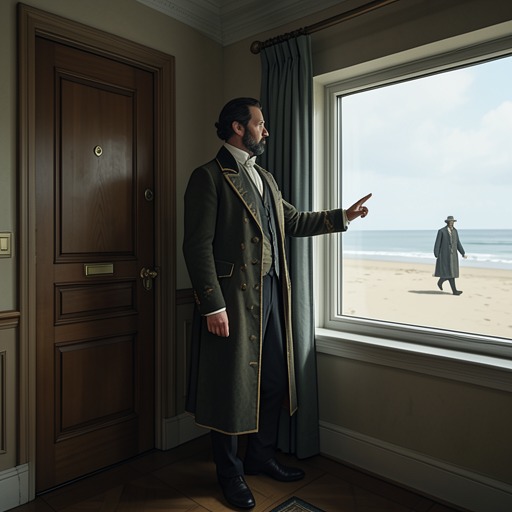
Its labyrinth becomes an instrument of concealment when Aschenbach follows Tadzio and his companions through the streets. He waits in hiding, keeps back when they stop, slips into shops and courtyards to let them pass, loses them in bridges and blind alleys, and suffers acute fear when he encounters them in a passage with no way out. When the group boards a gondola, he hires another boatman and pays him to follow at a distance. The pursuit turns the city’s narrow passages and waterways into a private route of surveillance. Aschenbach’s movements are furtive, but the narrative’s language identifies his intoxication and degradation; Venice’s maze gives desire a path while obscuring its moral cost.
Cholera, Concealment, and the Decision to Stay
During Aschenbach’s fourth week, signs of a concealed crisis accumulate around the resort. The number of hotel guests seems to be falling, and German speech grows scarce. A barber lets slip that visitors have left because of the plague, then evades Aschenbach’s questions. In Venice, Aschenbach recognizes a sweetish, medicinal odor that suggests sickness and wounds; it grows stronger in the narrow streets. The city’s atmosphere is no longer merely unpleasant: it supplies sensory evidence that official explanations and silences have something to hide.
Aschenbach understands the stakes clearly enough to imagine warning Tadzio’s mother. In his imagined speech, he would advise her to leave Venice with her daughters and Tadzio because the city is full of plague. He could then say farewell and escape. But he recognizes that he does not seriously want to carry out this plan. The thought of prudence and return produces revulsion, while his awareness that he shares in the truth and its concealment becomes intoxicating. He resolves to keep silent and remains in Venice. His choice links private desire to the city’s public failure to disclose the outbreak: protecting his access to Tadzio takes precedence over warning the family.
The outbreak intensifies the contrast between the city’s splendid public face and its concealed disorder. Unsuspecting foreigners continue to sit outside cafés and watch pigeons in the square, while the smell of sickness and the dwindling guests tell a different story. The danger does not force Aschenbach away; instead, the knowledge of it becomes part of the moral compromise that binds him to the place. Venice’s policy of concealment and his own silence echo one another, although the consequences of his private choice are most immediate for the family he refuses to warn.
Death and Narrative Significance
The story’s measured sequences of travel, delay, return, and repeated beach days end in abrupt finality. After Aschenbach has stayed through the danger and followed Tadzio through Venice, the narrative returns to the Lido, where the boy moves apart from both shore and companions. Aschenbach watches from his chair and perceives Tadzio’s glance as a smile and a signal inviting him onward. He rises as if to follow. Minutes pass before anyone hurries to help him after he collapses; he is carried to his room, and news of his death reaches the world that same day.
Venice’s narrative importance lies in this progression from desired destination to recurring refuge, from sensory enchantment to evidence of infection, and finally to the place of Aschenbach’s death. The city’s beauty is real within the story, but it does not guarantee safety or moral clarity. Its repeated scenes prolong the possibility of staying; its labyrinth enables pursuit; its concealed epidemic exposes what Aschenbach is willing to sacrifice for that continuation. The slow accumulation of routines and postponements gives way to a sudden ending, so that the holiday’s apparent suspension of ordinary life closes not with departure but with death.